 |
| Olive's Ocean by Kevin Henkes |
Summary: While Martha is preparing to leave on a family vacation to Godbee’s, she receives a note from the late Olive Barstow’s mother. The note sheds a bit of light on Olive’s personality and Martha is surprised to discover that they were a lot alike. While on vacation, Martha connects with her grandmother, begins writing, thinks about Olive, falls for a boy, gets her first kiss, almost drowns, bottles up some of the ocean, and finds new a new meaning and purpose for her life.
Bibliographic citation: Henkes, K. (2003). Olive's ocean. New York: Greenwillow Books.
Impressions: As the story began to unfold, I was expecting one of two things to be the reason behind the censored status of this book: either Martha was going to find out that Olive was obsessed with her in a homosexual sort of way, or Martha was going to commit suicide by drowning herself while visiting Godbee. When neither one of those was the case, I wondered why in the world the book was on the censored list! I actually had to look up a couple of reviews to see what the big deal had been. As it turned out, it was a challenged book because of Olive’s death and Martha’s 13-year-old brother talking about their parent’s “morning sex behavior” the morning after a big decision was announced to the family. Neither one of those things sent up a red flag…to me, an adult. As is the case with this book and as obvious as it sounds, I need to set my own life experiences aside and read books through the eyes of a child. If I had taken that approach, I would have realized the effect of the death of a young classmate on a school and community. I just assume that death will happen in books because it is a part of life, but for this to be a 12-year-old girl makes it that much harder to deal with and explain to the 12-and 13-year-old readers. The conversation between Martha and her brother referring to the “morning sex behavior” is somewhat inappropriate for a 13-year-old to be talking about. While some kids may not understand the reference to the “celebratory nature” of the big decision, many will...and it seems a little advanced for this age group.
Reviews:
“All of Henkes's strengths as a fiction writer — economy, grace, humor, respect for his characters, a dramatist's eye for gesture, and an underlying good-naturedness — are given wonderful play here.”
Ellis, S. (2003). Olive's Ocean. [Review of the book Olive’s Ocean, by K. Henkes]. Horn Book Magazine, 79(6), 745.
“With his usual sensitivity and insight, Henkes (The Birthday Room) explores key issues of adolescence, through the observations of aspiring 12-year-old writer Martha Boyle…In brief chapters, Henkes reveals Martha's discovery of life's fleeting qualities, her deepening bond with Godbee, and her first stirrings of romantic feeling and betrayal. Readers can peer through this brief window into Martha's life and witness a maturation, as she becomes a young woman, appreciates life anew and finds a way to give something back to Olive.”
Roback, D., Brown, J. M., Bean, J., Chenowith, E., & Zaleski, J. (2003). Olive’s Ocean. [Review of the book Olive’s Ocean, by K. Henkes]. Publishers Weekly, 250(33), 80. Suggested use: Looking at this story as a whole leaving the questionable sexual content out, there are many ways to use this book. Students could write their “hopes” on a piece of paper similar to the one Olive’s mom brought to Martha and then discuss what it would take to get from “hopes” to “reality.” If they could give their “hopes” to one person, who would it be and why? Students could brainstorm what they would want bottled up in a baby food jar and why they would want to hold onto that particular item(s). Students could also “help” Martha decide what to do with Jimmy’s film, giving support for their reasoning. They could also do a character comparison of Godbee to someone they know: a grandparent, teacher, etc. (I really loved Godbee’s character!)
_________________________________________________________
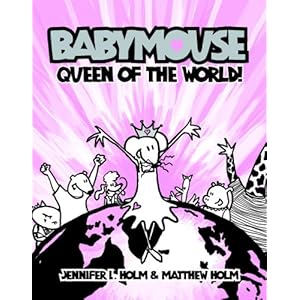 |
| Babymouse: Queen of the World |
Summary: Babymouse is a mouse with sass who wakes up every morning to the same ho-hum kind of life, free from excitement and adventure. However, she makes everything more exciting by enlisting the help of her imagination! When talk of Felicia’s slumber party gets out, Babymouse is determined to get an invitation, even if it means giving the popular girl her book report at the last minute. Following the disastrous start to the slumber party, Babymouse realizes that her life is not so bad and departs for a fun evening with her best friend, Wilson, instead.
Bibliographic citation:
Holm, J. L., & Holm, M. (2007). Babymouse, queen of the world!. New York: Random House.
Impressions: In this book, the part I liked the best was the interaction between Babymouse and the reader. It made parts of the story feel more like a conversation than a story. The busyness of the illustrations was a little distracting, but I understand their purpose. Where authors describe the story with words, Holm tells the story through drawings, which adds a strong (and necessary) visual element! Most people think of male students when the topic of graphic novels arises, but this is a refreshing change since it is geared toward females.
Reviews:
“The Holms spruce up some well-trod ground with breathless pacing and clever flights of Babymouse’s imagination, and their manic, pink-toned illustrations of Babymouse and her cohorts vigorously reflect the internal life of any million-ideas-a-minute middle-school student.”
Karp, J. (2005). Babymouse: Queen of the World. [Review of the book Babymouse: Queen of the World, by Holm, J. & Holm, M.]. Booklist, 102(7), 48.
“Creative dream sequences in these graphic novels let the reader into a vivid world of alternate possibilities complete with heroes, villains, and trusty sidekicks.”
Barbara Z Kiefer, Detra Price-Dennis, & Caitlin L Ryan. (2006). Babymouse: Queen of the World. [Review of the book Babymouse: Queen of the World, by Holm, J. & Holm, M.]. Language Arts, 84(1), 95. Retrieved August 10, 2012, from Research Library. (Document ID: 1135586191).
Suggested use: This would make a fun choral reading storytime. By giving pairs or trios of students a copy of a Babymouse book, they could separate into areas around the room and practice reading the story (similar to a play) by taking on the roles of the different characters. If time permits, students could “perform” the part(s) of the story that they enjoyed the most.


