Sew Cool

Monday, August 6, 2012

Module 10 - Olive's Ocean and Babymouse: Queen of the World

Olive's Ocean by Kevin Henkes
Summary:  While Martha is preparing to leave on a family vacation to Godbee’s, she receives a note from the late Olive Barstow’s mother.  The note sheds a bit of light on Olive’s personality and Martha is surprised to discover that they were a lot alike.  While on vacation, Martha connects with her grandmother, begins writing, thinks about Olive, falls for a boy, gets her first kiss, almost drowns, bottles up some of the ocean, and finds new a new meaning and purpose for her life.
     
Bibliographic citation:  Henkes, K. (2003). Olive's ocean. New York: Greenwillow Books.

Impressions:  As the story began to unfold, I was expecting one of two things to be the reason behind the censored status of this book:  either Martha was going to find out that Olive was obsessed with her in a homosexual sort of way, or Martha was going to commit suicide by drowning herself while visiting Godbee.  When neither one of those was the case, I wondered why in the world the book was on the censored list!  I actually had to look up a couple of reviews to see what the big deal had been.  As it turned out, it was a challenged book because of Olive’s death and Martha’s 13-year-old brother talking about their parent’s “morning sex behavior” the morning after a big decision was announced to the family.  Neither one of those things sent up a red flag…to me, an adult.  As is the case with this book and as obvious as it sounds, I need to set my own life experiences aside and read books through the eyes of a child.  If I had taken that approach, I would have realized the effect of the death of a young classmate on a school and community.  I just assume that death will happen in books because it is a part of life, but for this to be a 12-year-old girl makes it that much harder to deal with and explain to the 12-and 13-year-old readers.  The conversation between Martha and her brother referring to the “morning sex behavior” is somewhat inappropriate for a 13-year-old to be talking about.  While some kids may not understand the reference to the “celebratory nature” of the big decision, many will...and it seems a little advanced for this age group.  

Reviews:


“All of Henkes's strengths as a fiction writer — economy, grace, humor, respect for his characters, a dramatist's eye for gesture, and an underlying good-naturedness — are given wonderful play here.”
Ellis, S. (2003). Olive's Ocean. [Review of the book Olive’s Ocean, by K. Henkes]. Horn Book Magazine, 79(6), 745.

“With his usual sensitivity and insight, Henkes (The Birthday Room) explores key issues of adolescence, through the observations of aspiring 12-year-old writer Martha Boyle…In brief chapters, Henkes reveals Martha's discovery of life's fleeting qualities, her deepening bond with Godbee, and her first stirrings of romantic feeling and betrayal. Readers can peer through this brief window into Martha's life and witness a maturation, as she becomes a young woman, appreciates life anew and finds a way to give something back to Olive.”
Roback, D., Brown, J. M., Bean, J., Chenowith, E., & Zaleski, J. (2003). Olive’s Ocean. [Review of the book Olive’s Ocean, by K. Henkes]. Publishers Weekly, 250(33), 80. 

Suggested use:  Looking at this story as a whole leaving the questionable sexual content out, there are many ways to use this book.  Students could write their “hopes” on a piece of paper similar to the one Olive’s mom brought to Martha and then discuss what it would take to get from “hopes” to “reality.”  If they could give their “hopes” to one person, who would it be and why?  Students could brainstorm what they would want bottled up in a baby food jar and why they would want to hold onto that particular item(s).  Students could also “help” Martha decide what to do with Jimmy’s film, giving support for their reasoning.  They could also do a character comparison of Godbee to someone they know: a grandparent, teacher, etc.  (I really loved Godbee’s character!)
_________________________________________________________
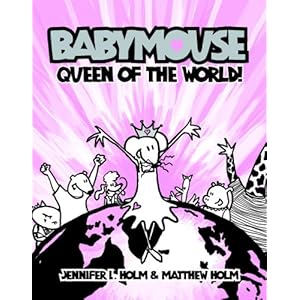
Babymouse #1: Queen of the World!
Babymouse: Queen of the World

Summary: Babymouse is a mouse with sass who wakes up every morning to the same ho-hum kind of life, free from excitement and adventure.  However, she makes everything more exciting by enlisting the help of her imagination!  When talk of Felicia’s slumber party gets out, Babymouse is determined to get an invitation, even if it means giving the popular girl her book report at the last minute.  Following the disastrous start to the slumber party, Babymouse realizes that her life is not so bad and departs for a fun evening with her best friend, Wilson, instead. 
         
Bibliographic citation: 
Holm, J. L., & Holm, M. (2007). Babymouse, queen of the world!. New York: Random House.

Impressions:  In this book, the part I liked the best was the interaction between Babymouse and the reader.  It made parts of the story feel more like a conversation than a story.  The busyness of the illustrations was a little distracting, but I understand their purpose.  Where authors describe the story with words, Holm tells the story through drawings, which adds a strong (and necessary) visual element!  Most people think of male students when the topic of graphic novels arises, but this is a refreshing change since it is geared toward females. 
     
Reviews:

“The Holms spruce up some well-trod ground with breathless pacing and clever flights of Babymouse’s imagination, and their manic, pink-toned illustrations of Babymouse and her cohorts vigorously reflect the internal life of any million-ideas-a-minute middle-school student.”
Karp, J. (2005). Babymouse: Queen of the World. [Review of the book Babymouse: Queen of the World, by Holm, J. & Holm, M.]. Booklist, 102(7), 48.

“Creative dream sequences in these graphic novels let the reader into a vivid world of alternate possibilities complete with heroes, villains, and trusty sidekicks.”
Barbara Z Kiefer, Detra Price-Dennis, & Caitlin L Ryan. (2006). Babymouse: Queen of the World. [Review of the book Babymouse: Queen of the World, by Holm, J. & Holm, M.]. Language Arts, 84(1), 95.  Retrieved August 10, 2012, from Research Library. (Document ID: 1135586191). 

Suggested use:  This would make a fun choral reading storytime.  By giving pairs or trios of students a copy of a Babymouse book, they could separate into areas around the room and practice reading the story (similar to a play) by taking on the roles of the different characters.  If time permits, students could “perform” the part(s) of the story that they enjoyed the most.

Module 9 - All the Broken Pieces and Amazing Faces

All the Broken Pieces by Ann Burg
Summary:  Matt Pin was removed from Vietnam and placed with a loving American couple.  He has many memories of his homeland, the war, his birth mother, and his injured little brother that fill his mind day in and day out.  Matt is a stand-out player on his middle school baseball team and learns to play piano from Jeff, a Vietnam vet.  It is also through Jeff that Matt is able to tell his story, hoping to show those who feel as though he’s the enemy that he was just a boy  put into the care of American soldiers.  Matt is also scared to share the story of his little brother’s life-changing injury, but is able to have closure when he finally talks to his American parents about the accident.  The blame is not his and their love is unending. 
               
Bibliographic citation: 
Burg, A. (2009). All the broken pieces : a novel in verse. New York: Scholastic Press.

Impressions:  In the coming days, I will be sending this book back to the middle school I borrowed it from.  I have included a post it note on the cover for my librarian friend to see when she receives it.  “An excellent read.”  That pretty much sums up the way I feel about this book!  Matt Pin’s story was one of second chances, a fresh start, the power of a family's love and support, and people's attitudes.  I was moved to tears at times, but comforted by Matt's parents as well.  They never pushed him to do or say more than he was ready for and I admired that patience and understanding!   

Reviews:

“Using spare free verse, first-time novelist Burg beautifully evokes the emotions of a Vietnamese adoptee as he struggles to come to terms with his past.”
All the Broken Pieces. (2009). [Review of the book All the Broken Pieces, by A. Burg]. Publishers Weekly, 256(15), 49.

“While most of the selections read less like poems and more like simple prose, the story is a lovely, moving one.”
Campbell, H. M. (2009). All the Broken Pieces. [Review of the book All the Broken Pieces, by A. Burg]. School Library Journal, 55(5), 101.

Suggested use:  This would be an excellent book for a read aloud due to the emotional element intertwined throughout.  It could also be used as a companion to a Vietnam War historical fiction novel written from another child’s point of view for compare and contrast purposes.
_________________________________________________________

Amazing Faces compiled by Lee Bennett Hopkins
Summary:  This beautiful book of sixteen poems compiled by Lee Bennett Hopkins revolves around emotions and feelings.  The illustrations do an amazing job capturing looks of joy, appreciation, sadness, aggression, excitement, love, and pride.  Emotions are universal, differing from situation to situation, and help to define who we are as individuals. 
        
Bibliographic citation:  (2010). Amazing faces. New York: Lee & Low Books.

Impressions:  Captivating.  These poems true to human nature and the illustrations are absolutely breathtaking.  Each face tells a different story and each poem gives the faces a voice.  Of all the poetry books I have read recently, this one is my favorite.   
     
Reviews:


"This appealing package of poetry and ideas will be enjoyed by children, parents, and teachers. There are many bits to savor."
Bush, M. (2010). Amazing Faces. [Review of the book Amazing Faces, compiled by L. B. Hopkins]. School Library Journal, 56(5), 131-132.

“The focus of this excellent collection of disparate poems is not strictly faces but people...The poems include character sketches, vignettes, and descriptions of people from all over multicultural America.”
Amazing Faces. (2010). [Review of the book Amazing Faces, compiled by L. B. Hopkins]. Publishers Weekly, 257(18), 49. 

Suggested use:  I thought of two ways to use this book.  The first is to read a handful of the poems – one at a time, without showing the matching illustration – to see if the kids can guess the emotion based on the words of the poem.  What key words from the poem help them know?  Have them guess what the illustration might look like based on their answers.  The other way I can see using this book is to show only a poem’s illustration and have the kids discuss the expressions on the people’s faces.  For older kids, they can create a poem to go along with the illustration.  I would probably give the poem’s title and a few select words to help the students get started writing their own poem.

Sunday, July 29, 2012

Module 8 - What Happened to Cass McBride? and 2095 (Time Warp Trio)

What Happened to Cass McBride? by Gail Giles
Summary:  After Kyle’s brother, David, commits suicide, Kyle goes after the person he feels is responsible.  He kidnaps Cass, buries her alive, and then taunts and yells at her.  Somewhere between the sarcasm, questions and answers between the pair, and Cass’ business-like, problem-solving approach to situations, they form a bond that ultimately saves her life.
 
Bibliographic citation:   
Giles, G. (2006). What mappened to cass mcbride?. New York: Little, Brown and Company.

Impressions:  The mystery surrounding Cass McBride was gripping and the layout of the book was interesting.  The story begins with Kyle being interrogated and providing flashback information about the kidnapping.  Then, Cass is giving us a play-by-play account of her time in the crate buried underground.  Meanwhile, the law enforcement gets involved and gives yet another perspective into the case.  The way the three vantage points weave together and reach the climax simultaneously is genius!  This book was hard to put down.  I couldn’t wait to arrive at the conclusion! 
     
Reviews:

“Giles's characters are frighteningly believable. The story is part mystery, part psychological drama that involves dysfunctional families and abuse, and part crime investigation.”
Quinones, S. (2007). What Happened to Cass McBride?. [Review of the book What Happened to Cass McBride?, by G. Giles]. School Library Journal, 53(2), 116.

"From the first paragraph, Giles's story grabs readers' attention, and doesn't let go…Giles does a terrific job of creating two well-rounded characters, and of withholding the outcome of Cass's fate until the very end. Readers will be riveted.”
What Happened to Cass McBride?. (2006). [Review of the book What Happened to Cass McBride?, by G. Giles]. Publishers Weekly, 253(45), 59.

Suggested use:  I have found a theme in several of the books I have read this summer.  Words can hurt.  This book allows for yet another opportunity to discuss character.  (I mentioned this same idea in my Pinduli post.)  Students assume that their words are transparent and easy to dismiss after a little time passes.  Not true.  Harsh, unkind words and the actions we demonstrate can leave a negative lasting impression on a person.  Cass’ note and David’s mother led David to make a decision that can never be undone.  Having discussions with students when they are impressionable is crucial in their social development.  The character development in this book lends itself beautifully to such discussions.
_________________________________________________________

2095 (The Time Warp Trio) by Jon Scieszka
Summary:  Joe, Sam, and Fred (the Time Warp Trio) travel to the year 2095 during a school field trip.  While there, they are hassled by robots and in find themselves in awe of all the futuristic gadgets.  After being chased by robots, the boys run into a trio of girls with names similar to their own.  Initially, the boys thought they were being chased by the girls as well, but they discover that the girls are actually relatives of the future.  The girls help the boys get back to the present time where the field trip continues.   
   
Bibliographic citation:   
Scieszka, J. (1995). 2095. New York: Viking.

Impressions:  I wasn’t too impressed with this book, but I feel I should read another one or two of Scieszka’s series before I make any real judgments.  I don’t feel that one snapshot of the series gives me a fair picture.  I can see where third, fourth, and fifth graders (especially boys) might think the series is ‘cool.’  The humor scattered throughout the book was clever, but the plot was a little ‘blah’ for my taste.  The boys meeting relatives of the future was probably the most appealing element of the book, one that I was not anticipating. 
      
Reviews: 

“This immensely satisfying and slightly longer addition to the popular series is full of humor, adventure, and booktalking opportunities.”
Connor, A. E. (1995). Book review: Grades 3-6. [Review of the book 2095, by J. Scieszka]. School Library Journal, 41(7), 81.

“[The Time Warp Trio’s] tongue-in-cheek humor, laced with understatement and wordplay, makes for laugh-out-loud reading.”
School Library Journal (n.d). 2095. [Review of the book 2095, by J. Scieszka].  Retrieved from http://www.amazon.com/2095-Time-Warp-Trio-Vol/dp/0142400440/ref=sr_1_1?ie=UTF8&qid=1344567328&sr=8-1&keywords=2095

Suggested use:  Most of us can look back and remember things we have seen, people we have met, and experiences we have had.  It’s always fun, though, to look ahead to the future, make predictions, and use our imaginations to think about things that have yet to come.  With this book, I would want to have older elementary students look ahead ten years to predict what their lives might be like.  What will they be doing?  What will they look like?  Who will their friends be?  What will be different in their lives, and how?  If they could go into the future to meet a relative that has yet to be born, who would they want to meet and why?  Kids aren’t often given opportunities to imagine in school, so this book provides just that…imagination!

Monday, July 23, 2012

Module 7 - George Washington's Teeth and The Boy on Fairfield Street

George Washington's Teeth by Deborah Chandra and Madeleine Comora
Summary:  This book is about exactly what the title says…George Washington’s teeth!  Written as a poem, the story outlines Washington’s struggle with teeth issues beginning at age twenty-two.  Some teeth were pulled out, some fell out, some got sore, and others rotted.  The day our first president was elected, he ‘elected’ not to smile because in his mouth, there were only two teeth.  Toothaches and anxiety about the problem filled his entire adult life and finally, as an elderly man, he was able to have an acceptable set of dentures made. 
       
Bibliographic citation:
Chandra, D. & Comora, M. (2003). George Washington's Teeth. New York: Farrar Straus Giroux.
 
Impressions:  All my life, I heard Washington’s teeth were made of wood!  After reading this book (as well as the wealth of information found in the timeline in the back of the book), I found out that they were actually made of hippopotamus tusk!  (The cover image even includes a hippo with a wide-open mouth and two tusks showing.  How clever!)  I had no idea I would enjoy this book as much as I did, but it will definitely be on my first book order at my new school. 
   
Reviews:

“Written in rhymed verse and illustrated with attractive watercolor illustrations, this book opens with an entertaining account of our first President's dental problems and succession of false teeth."
Christolon, B. (2005). George Washington's Teeth. [Review of the book George Washington’s Teeth, by D. Chandra & M. Comora]. School Library Journal, 51(8), 48.

“Chandra and Comora serve up George Washington's dental problems twice--first as an amusing confection, the facts sauced with fanciful enhancements; then as ungarnished, documented chronology, guaranteed to evoke admiration and empathy for a man who managed to function despite lifelong torment.”
Long, J. (2003). George Washington's Teeth. [Review of the book George Washington’s Teeth, by D. Chandra & M. Comora]. Horn Book Magazine, 79(2), 200.

Suggested use:  February is Dental Health Month.  This book can be used anytime during the month and could even be paired with a nonfiction book about caring for teeth or oral hygiene.  Kids could learn about our famous first president in a fun, poetic way and understand why all the pictures we see of him show a grumpy-looking man who never smiled.  Now we know why!  From there, a health mini-lesson could provide students with information about their own teeth and ways to keep their mouthful of pearly whites clean and healthy.

______________________________________________________

The Boy on Fairfield Street by Kathleen Krull

Summary:  The boy who grew up to become Dr. Seuss loved reading and animals, being adventurous with his neighborhood children, and taking part in various outdoor activities with his father.  At one point during his childhood, Ted Geisel realized all the ways he differed from other children and began drawing…the more outrageous, the better!  College wasn’t helping him blossom into the person he wanted to be, so he left.  His life’s focus was drawing and doodling and eventually led to a promising new life in New York.  The rest is history.   
        
Bibliographic citation:  Krull, K. (2005). The boy on fairfield street, how ted geisel grew up to become dr. seuss. New York: Random House.

Impressions:  My favorite part of the entire book was finding out about Ted drawing on his bedroom walls, horrifying everyone…except his mother!  That speaks volumes of her character to enable her son to flourish by allowing him a harmless outlet for his creativity.  (Will I be that kind of mom?  I hope so.)  To read about how few teachers and people had any faith in him outside the home saddened me.  From those experiences, he rose up from the negativity and became a well-known writer and illustrator.  A favorite of many!  Stories about the underdog inspire me…this book being one of them! 
     
Reviews:

“An affectionate survey centered on Ted Geisel's boyhood, plus a bit on his brush with higher education (neither Dartmouth College, where he was voted 'Least Likely to Succeed,' nor Oxford University engaged his full attention), concluding with the first months of his career.”
Long, J. (2004). The Boy on Fairfield Street: How Ted Geisel Grew Up to Become Dr. Seuss. [Review of the book The Boy on Fairfield Street, by K. Krull]. Horn Book Magazine, 80(1), 103.

“Krull's fond tribute to Dr. Seuss focuses on the well-loved author/artist's youth…Featured in spot art, familiar Seuss characters frolic through these pages, thematically complementing the illustrations while reminding readers why Geisel's life is worth celebrating.”
Roback, D., Brown, J. M., Bean, J., & Zaleski, J. (2004). The Boy on Fairfield Street: How Ted Geisel Grew Up to Become Dr. Seuss. [Review of the book The Boy on Fairfield Street, by K. Krull]. Publishers Weekly, 251(2), 54.

Suggested use:  I would use this book in March around Dr. Seuss’ birthday in conjunction with other biographies about him.  It would be fun to have the students create a mock interview with made-up questions stemming from information in the biographies.  One student could pretend to be Dr. Seuss and another could be the interviewer.  Student(s) are asked about situations Dr. Seuss found himself in and respond according to how he might have responded.

Thursday, July 12, 2012

Module 6 - The Wednesday Wars and The Other Side

The Wednesday Wars by Gary Schmidt
Summary:  Holling Hoodhood is forced to stay with his English teacher on Wednesday afternoons while his Catholic and Jewish classmates leave early to go to religion classes.  During this time together, Mrs. Baker introduces him to Shakespeare.  The literature grows on him after awhile and he actually starts to enjoy it!  Holling’s entire seventh grade year is outlined in the book, including his newfound appreciation for Shakespeare, frustration with his father’s architecture business, an encounter with rats, lots of chalk dust, delicious cream puffs, having to wear tights and feathers, and people he knows dealing with Vietnam. 
         
Bibliographic citation:  
Schmidt, G. (2008). The wednesday wars. New York: Clarion Books.

Impressions:  I read the companion book to The Wednesday Wars (Okay for Now) back in October so when I saw this one on the reading list, I jumped at the opportunity to read it!  I am not much of a Shakespeare fan, but between Mrs. Baker’s and Holling’s comments, this book created some appreciation in me.  Mrs. Baker’s teaching style, personality, and approach to education were what every kid deserves and I found myself respecting her more and more.  Holling’s character made me laugh out loud…several times!  And having already read Okay for Now (about Doug Swieteck and his older brother), I already felt connected to a couple of the characters in Holling’s life.  I give this book five stars! 
        
Reviews:

“The Wednesday Wars is truly one of those books that the reader hates to see end.  Schmidt provides a very satisfying ending…”
Blasingame, J., & Boreen, J. (2007). The Wednesday Wars. [Review of the book The Wednesday Wars, by G. Schmidt]. Journal Of Adolescent & Adult Literacy, 51(1), 77-78.

“The serious issues are leavened with ample humor, and the supporting cast--especially the wise and wonderful Mrs. Baker--is fully dimensional. Best of all is the hero, who shows himself to be more of a man than his authoritarian father.”
The Wednesday Wars. (2007). [Review of the book The Wednesday Wars, by G. Schmidt]. Publishers Weekly, 254(16), 51.

Suggested use:  I envision this book being utilized with ELAR classes alongside Shakespeare!  Throughout the year, Holling is asked to read several of Shakespeare’s most popular plays, and from each one, he takes away something worthwhile.  Using this book (or parts of this book) as a preview for an upcoming Shakespeare unit could be beneficial to students.        
____________________________________________________________
The Other Side by Jacqueline Woodson
Summary:  The story of two girls – Clover and Annie – living on opposite sides of a fence is told in this gorgeous book.  Annie, the white girl, sits on the fence while Clover, the black girl, wonders what she’s doing.  They don’t play together and they don’t talk to each other, they only look at each other.  Finally, one day Annie speaks to Clover and they become friends, first sitting on the fence together and then finally jumping rope together. 
            
Bibliographic citation:   
Woodson, J. (2001). The other side. New York: G. P. Putman's Sons. 

Impressions:  I almost didn’t choose to read this book.  How unfortunate that would have been!  Although there are minimal words due to the fact that The Other Side is a picture book, I saw excellent character development in the words that were there as well as from illustrations.  Wow!  The last page is my favorite.  The girls all together on the fence looking ahead to the future with hope and anticipation. 
  
Reviews:

“Beautifully realistic and expressive watercolor illustrations complement the text.”
Oluonye, M. N. (2004). The Other Side (Book). [Review of the book The Other Side, by J. Woodson]. School Library Journal, 50(10), 66.

“Written from the point of view of a black child, this book employs the powerful symbol of a fence to emphasize the racial division in a southern town…Wonderfully expressive watercolor paintings executed in soft pastels and restful greens appeal to the reader; they also help to communicate the feelings of the characters and the simple lifestyle in the small rural town. This is a lovely picture book for all ages.”
Feehrer, B. B. (2001). The Other Side [Review of the book The Other Side, by J. Woodson]. Library Talk, 14(4), 48. 

Suggested use:  This book would make a great companion to a picture book about Martin Luther King, Jr.  A kid-friendly research project could open a child’s eyes to how people were treated differently because of their skin color and how MLK, Jr. came along and changed things.  Along with this, I would talk about diversity and embracing differences in one another.  Something I found on pinterest along these same lines showed a white egg shell and a brown egg shell near their respective “insides”…the eggs inside the shells were identical!  What a powerful message! 

Monday, July 9, 2012

Module 5 - Flawed Dogs and Skellig

Flawed Dogs by Berkeley Breathed
Summary:  Sam the dachshund is destined to be a show dog, but Heidy comes along in a chance encounter and Sam just knows he wants to belong to her.  While Heidy and Sam are together living happily at her Uncle Hamish’s house, Cassius, a jealous poodle, sees the potential in Sam and begins to plot against him.  After Sam is sent away, he crosses paths with a group of strange-featured dogs who help him raid the Westminster Dog Show, overthrow Cassius, and win back his beloved Heidy.  
         
Bibliographic citation:  
Breathed, B. (2009). Flawed dogs. New York: Philomel Books.

Impressions:  Flawed Dogs was an easy, enjoyable read.  There were several features of the book I appreciated, including the every-now-and-then colored illustrations mixed in with the black and white illustrations.  They really brought the story to life!  Just as his word choice was right on target, so too were his illustrations!  It is apparent that Breathed really worked on getting the expressions just right for every character and every dog.  Even on the cover, Sam’s expression is priceless.  Although there was a theme of neglect and abandonment intertwined throughout the story, the humor balanced it out so I finished the book feeling satisfied.  An excellent book I look forward to recommending to my elementary students!  
    
Reviews:


“The writing is playful and the illustrations, most in black and white, are outstanding.”
Cuseo, A. (2010). Flawed Dogs. [Review of the book Flawed Dogs, by B. Breathed]. Catholic Library World, 81(1), 77-78.

“A moving tale about the beauty of imperfections and the capacity for love.”
Flawed Dogs: The Shocking Raid on Westminster. (2009). [Review of the book Flawed Dogs, by B. Breathed]. Publishers Weekly, 256(29), 140.

Suggested use:  I can see this book being used to teach prediction skills: reading portions aloud to students and then stopping at a point where they have to decide what might happen to the character(s).  There are many different settings (the airport, Uncle Hamish’s house, the apartment, the flawed dog’s underground area, the dog show) so the students would have ample opportunities to predict how they, along with the characters, collectively effect the outcome of the story.  Another activity would be to examine each of the flawed dogs’ characteristics to see what their strengths are.  Then, the students could create an adoption ad that highlights the unusual features in a positive way and might lure in the right type of owner.

______________________________________________________________
Skellig by David Almond

Summary:  After moving to a new neighborhood and into a fixer-upper of a house, Michael begins to fend for himself while his parents are away with his infant baby sister at the hospital.  Upon exploring the old, falling down garage, Michael discovers a male creature of some kind living behind some old furniture eating bugs and other strange things.  Intrigued, Michael wants to help him and get to know him so he helps the creature, named Skellig.  Mina is a free-spirited, intelligent neighbor girl with whom Michael befriends and shares his secret.  Together, they bring Skellig to a place where he can begin to live life again as a mysterious being…part angel, part bird, part man?  (The reader never really finds out exactly what he is.)  Michael and Mina are forever changed as well as a result of their experiences with Skellig.
              
Bibliographic citation:  
Almond, D. (1999). Skellig. New York: Delacorte Press.

Impressions:  This book is not something I would have normally read, but I truly enjoyed it!  Mina was my favorite character and I enjoyed how she humorously scoffed at the school system Michael was a part of.  In her interactions with Michael, she taught him a great deal, and to be honest, I learned a few things too!  I look forward to reading the recently published book about Mina.  The mystery surrounding Skellig’s identity was a bit odd, but it was somewhat fascinating to think about Michael’s discovery and willingness to befriend such a strange, unknown living being without much fear or apprehension. 
            
Reviews:  


“In his first novel for children, British author David Almond has given them something singular to reach for.”
Vasilakis, N. (1999). Skellig. [Review of the book Skellig, by D. Almond]. Horn Book Magazine, 75(3), 326.   

“The plot pivots on the question of what Skellig is. It is a question that will keep readers moving through the book, trying to make sense of the cleverly doled out clues. The beauty here is that there is no answer and readers will be left to wonder and debate, and make up their own minds. A lovingly done, thought-provoking novel.” 
Dollisch, P. A. (1999). Skellig [Review of the book Skellig, by D. Almond]. School Library Journal, 45(2), 104.

Suggested use:  This would be a great book to use with a “What if…?” discussion.  What would you do if you were in Michael’s position and found a living creature or being?  If he or she was nameless, what would you call it?  Would you be scared?  Why or why not?  What if you could make up a creature similar to Skellig?  What features would your creature have?  What would it eat?  How would it move?  I can see a multitude of discussion starters allowing students to venture off into the world of fantasy and imagination.

Thursday, July 5, 2012

Module 4 - After Ever After and Ivy + Bean (Book 8)

After Ever After by Jordan Sonnenblick
Summary:  Being a “normal” teenage boy is tough, but being a cancer survivor in remission is even tougher!  School struggles (especially math), a looming standardized state test, physical effects from treatment chemicals, issues at home, a distant brother, and a cute girl are all things Jeffrey deals with during his 8th grade year.   His spitfire-of-a-best friend, Tad, is also a cancer survivor and struggling with some of the same issues.  They set goals for each other to achieve, and through perseverance and sacrifice, help each other reach them (to some degree).  This book is filled with humor, success, personal drive, sadness, and survival. 
               
Bibliographic Citation:   
Sonnenblick, J. (2010). After ever after. New York: Scholastic Press.

Impressions:  After Ever After is another one of my summer favorites!  I read this book all in one day due to the fact that I was unable to put it down.  Unfortunately, the standardized test that caused Jeffrey so much grief and stress throughout the book hits a little too close to home.  Testing is the current driving force in education, and to me, it’s a real disadvantage to teachers and kids.  Also, to read about a character struggling with math saddened me.  Math is my favorite subject and I have a heart for helping others, so I felt connected to Jeffrey in a teacher-student sort of way.  Having been a math tutor for four years, I applaud Tad’s tutoring efforts! 
Tad’s situation brought tears to my eyes even though I could feel something coming.  He was a true friend to Jeffrey despite the rude, somewhat disrespectful personality traits that readers see.  It’s obvious he would have done anything for Jeffrey.  Overall, I love the bond shared between the two boys and caught myself laughing at their interactions.  Sonnenblick’s perfect word choice mixed with emotion and heart make this book what it is!  Two thumbs WAY up!  
        
Reviews:

“Sonnenblick’s writing style is vivid, humorous, and authentically reflects the conversations and thoughts of most teens.  The plethora of imagery and metaphors add to the richness of the text.  The author pulls the readers into the world of a teen, giving them the opportunity to experience firsthand how life is viewed from a teen’s perspective.”
Kennedy, M. (2010). After Ever After. [Review of the book After Ever After, by J. Sonnenblick]. Journal Of Adolescent & Adult Literacy, 54(4), 299-301. doi:10.1598/JAAL.54.4.9

“Sonnenblick explores the emotional and physical aftermath of childhood cancer, ground rarely tread in books for children, with a sensitive but light touch, offering thought-provoking details…”
Gross, C. E. (2010). After Ever After. [Review of the book After Ever After, by J. Sonnenblick]. Horn Book Magazine, 86(2), 73. 

Suggested Use:  After Ever After would be a good book to use with middle school kids in a book club setting before or after school.  Allowing students to read about Jeffrey and Tad while discussing their trials and struggles would be an eye-opening experience for kids who are healthy, “normal,” and who often take their teenage life for granted.  Discussions can be powerful ways to implant perspective into the minds of young people.

______________________________________________________________

Ivy + Bean (Book 8) by Annie Barrows
Summary:  Ivy and Bean are a couple of girls who would give anything for some cheese – the kind of cheese that comes enclosed in red wax in a “just-for-you” serving size.  The entire book is centered around cheese, how jealous they are that their friends have some, what they would do if they had some, ways to earn money to get some, and what they do when they finally get their hands on some.  Bean’s dad gives the girls an idea to go door to door selling (and writing) a homemade newspaper highlighting the news of the neighborhood.  The girls go about obtaining their news in a spying sort of way and draw conclusions based on what they observe and hear.  Needless to say, they are slightly inaccurate and have set themselves up to make a few enemies.  In the end, the girls earn their cheese and couldn’t be happier. 
 
Bibliographic citation:   
Barrows, A. (2011). Ivy + Bean : no news is good news. San Francisco: Chronicle Books.

Impressions:  Ivy and Bean are cute characters with lots of imagination and seem to be quite a pair!  They are funny, intelligent, and down-to-earth so I feel elementary aged girls would enjoy reading about their silly adventures!  I like how the story progressed from the girls having a problem, then a solution, and finally, showing that hard work pays off.  At some level, Ivy and Bean can serve as inspiration to little girls who have big dreams and attainable goals!

Reviews: 

“Like Ivy and Bean, author Barrows and illustrator Blackall feed off each other’s creativity with hilarious results." 
Brabander, J. M. (2012). Ivy + Bean: No News Is Good News. [Review of the book No News is Good News, by A. Barrows]. Horn Book Magazine, 88(1), 84.

"One of the funniest young chapter book series around."
The Horn Book (n.d). Ivy + Bean: No News Is Good News. [Review of the book No News is Good News, by A. Barrows].  Retrieved from http://www.amazon.com/gp/product/0811866939/ref=dp_proddesc_1?ie=UTF8&n=283155 

Suggested use:  Elementary aged girls could use the aforementioned “inspiration” and actually follow in Ivy and Bean’s footsteps selling and writing a newspaper or article about the goings-on at school or in their particular grade level.  They could write about the cafeteria menu, upcoming or in-progress projects, teacher spotlights, student achievements, and other interesting bits of information.  The project could serve as a fundraiser for the library for new books…books that the girls help choose!